RVU: Community Concept & Foundational Models
Our strategy treats the community as an integrated ecosystem where villagers share directly in the planning, building, and running of their own neighborhood.
Themed Communities
Each community should be deliberately themed to meet the specific socio-economic needs of targeted groups, including veterans, recruits, international soldiers, humanitarians, and specific Internal Displaced Persons (IDPs), such as elderly or family farm households.
Community Layout
Communities will feature high-quality mini-homes anchored by a central Razom Community Center, designed to meet the common needs of its residents. The Razom Center can serve as a multi-purpose common area for Research & Development (off-grid infrastructure/biomass heating, frontline products, etc.), education & training, medical services, business incubators, computer center, farm animal housing, a resource/tool library, or any other common needs.
Based on Success
Our community design is rooted in proven international frameworks including:
Community First Village (Austin, Texas)
Valor Farm (Altavista, Virginia)
Bouldercrest Foundation (Bluemont, Virginia)
Dr. Adenrele Awotona, University of Massachusetts Boston, has been a long-time proponent of decentralized, community-managed infrastructure (localized micro-grids, regional water management) that can withstand systemic shocks and localized war damage. He has advocated foundational approaches to war-prone areas for reconstruction and development including rebuilding using "safe zones" during ongoing conflict.


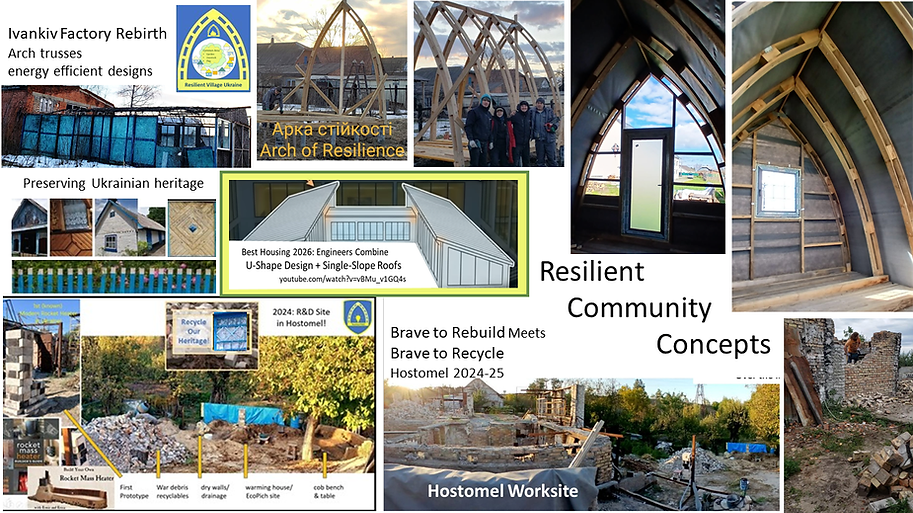
Introducing Resilient Structures to Ukraine
Adapting InnovativeTechniques in Efficient Housing to War Zone Conditions
U-Shaped - Climate Compatible
Angled and built for maximum energy efficiency
Uses simple lean-to construction techniques
can be designed as small, efficient duplex
to match communty tiny home goals.
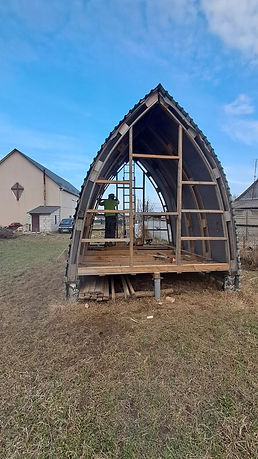
Arch Truss - Strong & Simple Engineering
Pre-assembled wooden trusses manufactured at our Ivankiv factory.
Can be delivered or picked up where needed for fast, simple construction
houses, community centers, R&D labs, out-buildings, animal shelters,
greenhouses, and military structures.

On-Site Reconstruction & Innovation
Physical buildings are designed to be constructed rapidly using locally available materials and repurposed wartime waste, ensuring communities remain self-reliant even if commercial supply chains are disrupted. One of the projects of the Razom Center could be designing substitutes for unavailable materials.
Extensive Use of Recycled/Repurposed War Debris: Where destroyed homes are common, the use of war debris can keep costs low and retain the identity of a community. For example, the use of salvaged traditional windows could be combined with a simple plexiglas inner window for better insulation and safety from glass shards in case of future attacks.
Adapt InnovativeTechniques in Efficient Housing:
U-Shaped: angled and built for maximum energy efficiency can be designed according to RVU standards
Arch Truss: Pre-assembled wooden trusses are manufactured at our Ivankiv factory. They can be delivered or picked up where needed for fast, simple construction of houses, out-buildings, animal shelters, greenhouses, and military structures.
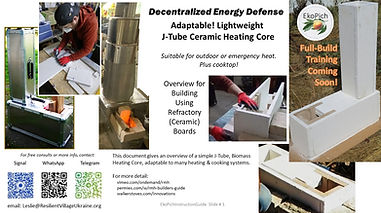
EkoPich Emergency Heaters: A lightweight, portable J-Tube ceramic heating core designed for quick assembly and rapid deployment to meet urgent winter heating and cooking needs.
Building Eco-Friendly Businesses to Rejuvenate the Local Economy: All of this locally produced innovation can lead to future businesses and grant potential.
Rocket Mass Heating (RMH) Systems: Using recycled bricks, concrete, and natural materials often free on the site, persons with little training can build state-of-the-art RMH units. These systems use thermal benches as a "battery" to draw heat, warming a small house or large room using 1/10 the wood of a standard stove, delivering radiant heat for up to 48 hours after the fire goes out.
Cob & Natural Building Techniques: RMH systems are built using these techniques. They can also be used to create fences, furnishings --even a compmplete home--from sand, clay, straw, broken brick and concrete debris. All of these may be available within the property.
Local Capacity & Economic Sustainability
A resilient village must work toward self-sufficiency and independence for its own safety and security. We use a train-the-trainer model to turn survival workshops into long-term growth, expansion, and business potential.
The Local Economy: Developing new skills is structured to not only reduce cost, but also to generate income. Community members can be trained to construct simple, small houses for themselves or for local rental income. Even the potentially large and well engineered arch truss structures can be easily assembled with pre-built trusses from our factory in Ivankiv. Cob building, RMH design, facility rentals at the Razom Center, and specialized agricultural training all serve as local business incubators.
Civilian-Military Integration: We build localized networks where we train civilians to take over non-combat support tasks (logistics of moving a casualty's gear, running errands for confined personnel, administrative family outreach, etc.) In return, military personnel help train local civilian teams in localized defense, tactical medicine, and explosives detection. Veterans and active-duty military in need of short-term local housing would be welcomed additions for all communities, especially given their valuable skill sets.
Bringing it All Together: We are seeking to integrate all activities under the umbrella of the International Association of Emergency Managers (IAEM.org) through their internal mechanisms such as the Infrastructure Consortium and and Higher Education outreaches to establish global standards, gain support, and credibility for RVU work.
The Battlefield Rubble Dilemma: Asbestos Containment
Reusing war debris presents an invisible health crisis: widespread contamination from decades of historic asbestos construction. Resilient Village Ukraine addresses this through the Asbestos Containment Project.
The Problem: Traditional bulldozing and trucking away of rubble creates toxic dust clouds and massive mountains laden with loose asbestos chunks, creating secondary public health risks for decades.
Our Grassroots Solution: At our site in Hostomel, rather than disturbing the material or transporting it blindly, we researched and applied better handling techniques to safely isolate and entomb asbestos on the original site using natural building methods (such as cob sealing), preventing the fibers from spreading widely and becoming airborne.
Strategic Partnerships: To ensure rigid on-the-ground safety standards, our R&D projects seek the homeowners or local community volunteers to clean up home sites. We are currently seeking advice and potential partners from both academic and practicioner areas of expertise.
